When to ChangeCoolant (Antifreeze)
When to change coolant: on the manufacturer's schedule, by mileage or years, whichever comes first. Change it earlier if it turns cloudy, changes color, shows sediment or an oily film, after overheating or cooling system repair, or if water or an unknown fluid was added. Even if it looks clean, its anti-corrosion additives wear out with time.
Why change coolant at all
Coolant is not only about not freezing in winter. Its main job all year is to carry heat away and protect the system from the inside. Additives prevent metal corrosion, deposits and water pump wear, and lubricate seals. These additives are used up gradually. Old coolant can look clean but no longer protect the radiator and block from corrosion. In Batumi's hot humid summer and on mountain climbs the cooling system works especially hard.
Signs it is time
- The scheduled interval has come — the manufacturer states it in the service book or manual. Intervals vary between cars and fluids.
- The color has changed, the fluid is cloudy, brown or rusty.
- Sediment, flakes or deposits in the expansion tank.
- Oily film or emulsion — a reason to run diagnostics as well as change the coolant: oil may be entering through the head gasket or oil cooler.
- The engine overheated — the fluid may have partly boiled off and lost its properties.
- Water or an unknown fluid was added.
- Sweet smell in the cabin, misting windows — the heater core may be leaking.
Coolant types: why "any" will not do
Coolants differ by additive package: silicate (older type), carboxylate (organic, OAT), hybrid and low-silicate variants. Different manufacturers require different types to suit their system's materials — aluminum, seals, the pump.
Important: color does not define type. Pink coolant from one brand can have completely different chemistry from pink coolant from another. The guide is the car manufacturer's approval on the bottle. Mixing incompatible types can cause sediment and weaker protection.
Can I top up with water?
On the road, to get home — yes, preferably distilled. But water dilutes the mix: boiling and freezing points change and corrosion protection drops. After such a top-up, check the fluid and replace it if needed.
Drain and fill or flush
- Drain and fill — drained through the radiator tap or lower hose. Some old fluid stays in the block and heater.
- With a flush — the system is flushed to remove the remains and deposits. Needed when changing coolant type, after mixing, with sediment or rust.
- Machine exchange — old fluid is pushed out by new under control, so replacement is more complete.
Which option is right depends on the fluid's condition and the car's history.
After the change
Air must be bled from the system: an air lock can cause overheating and a cold heater. The level is checked again after a few drives.
If coolant keeps disappearing
The level should not drop noticeably between changes. If you top up regularly, look for a leak: radiator, hoses, water pump, heater core, head gasket. Then cooling system repair comes first, fluid change second.
How much it costs
The price depends on system capacity, the coolant type required, whether a flush is needed and how hard it is to bleed air on a particular model. Reference price at PRO SERVICE: from … GEL.
Where to check the cooling system in Batumi
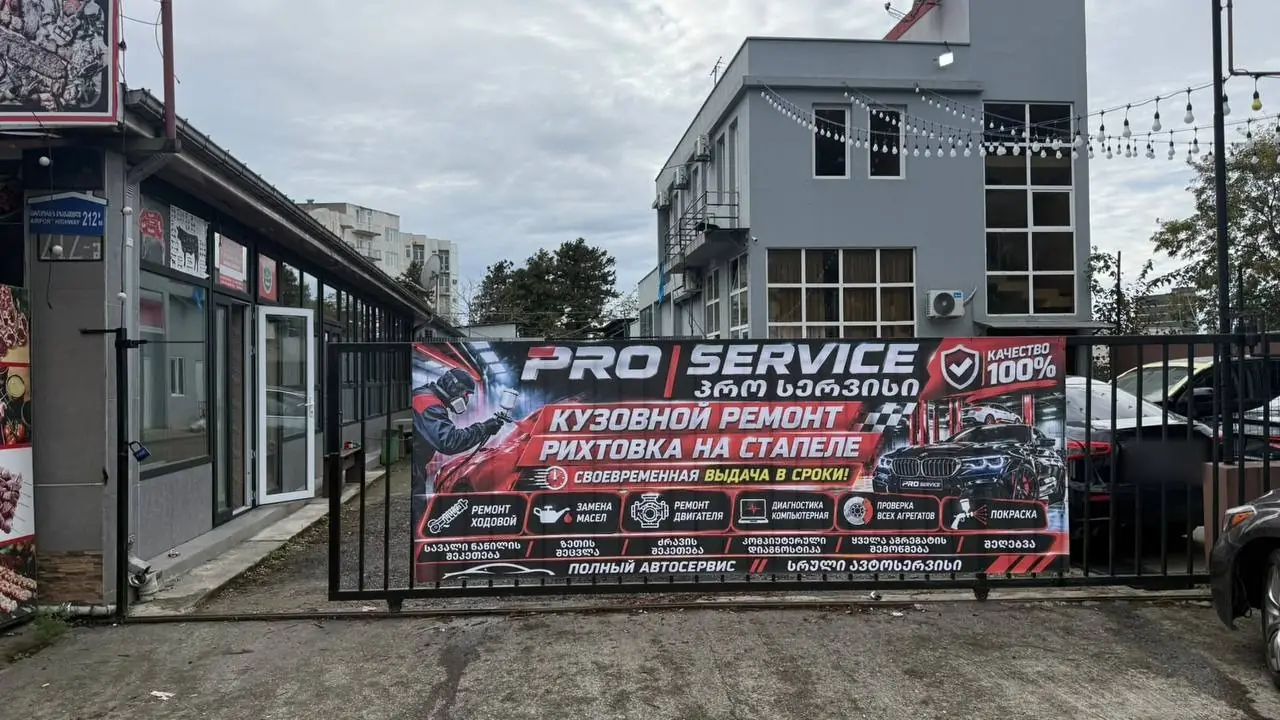
If the level keeps dropping or the engine runs hot, PRO SERVICE, Airport Highway 212, Batumi, handles cooling system repair: leak search, pressure test, water pump, radiator. The fluid service itself is described on the coolant change page.
FAQ
Can I mix coolants of different colors?
Type and approval matter, not color. If the type is unknown, it is better to replace it fully.
Is a flush needed every time?
No. It is needed when changing type, with sediment, rust or after mixing.
Why does coolant boil over?
A faulty tank cap, thermostat, fan, clogged radiator or air in the system.
I bought a used car and do not know what is inside?
It makes sense to replace the coolant with the correct type — cheap insurance.
Can I top up with water instead of coolant?
On the road, in an emergency — yes, to get home. But water dilutes the coolant: protection against corrosion and overheating drops, and in the mountains in winter — against freezing. After such a top-up the system should be checked and the fluid replaced if needed.
Why does coolant disappear with no visible leak?
It can escape through a loose reservoir cap, drip onto a hot engine and evaporate at once, or get into the cylinders through the head gasket. If the level drops regularly, a pressure test of the system is needed.
● 06 · Contact
Send a photo — get a price
Describe what happened and attach 2–3 photos of the damage. We reply with a cost and time estimate.
- Address
- Airport Highway 212, Batumi, Georgia
- Directions
- Open in Google Maps ↗